Friday, April 30, 2010

A Good Morning

Boy do I love tracking. I went out this morning not expecting to find anything crazy and ended up seeing so much cool stuff. I found the spot where a hawk killed a Blue Jay, which I recognized from the scat spray- a thing that only hawks do. I found the tracks of a mother red fox bringing her pups down to a pool to drink. I caught an American toad and got it to make tracks for me. Found some nice Raven tracks and some really nice duck tracks. I thought they were grouse tracks which was very exciting for me because grouse is one of the last species whose tracks I need to find for the Apprenticeship but it turns out that the tracks were from some weird duck wandering around in the forest.

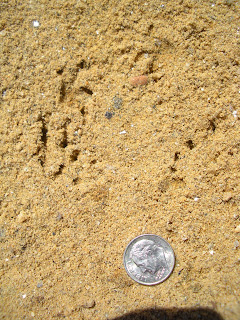
I also got to trail a Coyote, Gray fox, deer and Moose for a long distance in the sand.

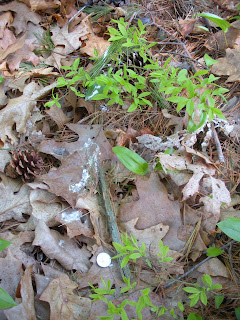
Here is the blue jay kill site. The white stuff is scat sprayed out by a hawk. Could be a Buteo (Red Tail, Red Shoulder etc) or an Accipter (Sharp shinned, Cooper's). Its most likely an accipiter kill, since blue jays are hard for a Buteo to catch. Owls don't make the scat spray.
Size reference on the toad:

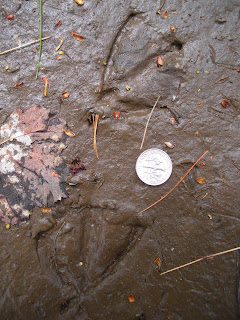
Forest duck and toad tracks.


Red fox puppy. This is known by the size (which might suggest Gray fox) and the caloused ridge at the base of the heel.

Tuesday, April 27, 2010

Collection of Tracking Quotes

Here are a few of my favorite quotes about tracking. Hope you like them.

Tracking is like dancing, because your body is happy. It is telling you the hunting will be good. You feel it in the dance. It tells you when you love tracking and dancing, you are talking with God.
- !Ngate Xgamxebe, Bushman Tracker, from the documentary The Great Dance.

Never forget the trail, look ever for the track in the snow; it is the priceless, unimpechable record of the creature's life and thought, in the oldest writing known on earth.
-Ernest Thompson Seton

The tragedy in life is not what men suffer, but what they miss.
-Thomas Carlyle

Jungle lore is not a science that can be learnt from textbooks; it can, however, be absorbed, a little at a time, and the absorption process can go on indefinitely, for the book of nature has no beginning as it has no end.
-Jim Corbett, Jungle Lore

I'll add more as I come across them...

Friday, April 23, 2010

Small Island Ecology

For this past Tracking weekend we took a ferry out to Ragged Island about 16 miles off of the coast of Maine. The only mammals on the island are Snowshoe Hare, Muskrat, and Norway Rats. So we studied their tracks and sign closely and also did a lot of bird tracking. We found Bald Eagle tracks, crow, pheasant, seagull and many other bird tracks. It was a great weekend spent on a very unique and beautiful island. Here are some pictures:


Tuesday, March 16, 2010

Stone Knife

I've always wanted a stone knife that I could use to carve friction fire kits or whatever else I might need it for when working on a program. I like how this one turned out. Its very durable chert from Texas and the handle is Paper Birch. It works great for wood working and the blade is big so I hope it will last through many resharpenings.

Lynx Tracking Expedition

Had an amazing weekend tracking Lynx in the very northern tip of Maine. We stayed at a remote French-Canadian logging camp. Here are some pictures. I got to drive a snowmobile and check/reset a trap line with the head biologist. Also had some fun moments getting separated from the group without a radio and having to track them down, riding in the back of a 1970s Land Rover, getting pulled over by Border Patrol with a Canadian in the car that didn't have her passport, and other similiar adventures. It was a fun trip.

Thursday, March 4, 2010

Hawaii Pictures

Good man Andy sent me a disc with some more pictures from our trip. Here they are:


Monday, February 22, 2010

Kamana Program

The Kamana Program is something I've been working on for nearly three years now. It has been very rewarding and very educational. Half of the program is book work, researching plants, mammals, herps, natural hazards etc. The other half is awareness training in nature and cultural training.
For example, my current research project is to list all of the valuable non-woody plants within 100 miles of where I live. By a "valuable" plant I mean that it is either edible, medicinal, poisonous, an ecological indicator, craft value or ethnobotanical uses. This project is comparable to a masters program in botany. It was a lot of work.
This is my current awareness assignment, along with sit spots and field inventories. It's to create an introduction of myself and where I'm from in a Native way, being sure to hit on several main points and fluff it up with lots of imagery. Here it is so far:
Greetings,
I lean against this glacially dropped boulder of mica-granite, reminded of the power that the Laurentide Ice Sheet brought with it as it carved out huge ridges, polished mountain tops and left behind lakes and boulders like this one. Slowly the bare soil of glacial till gave way to wind dispersed plants later to be succeeded by Hemlock, White Pine, Birch, Oak, Hickory, Beech, Elm and American Chestnuts. Over time and Native American influence these trees grew to amazing heights of more than 200 feet and 8 feet diameters. Since then these giants have fallen to ax or disease and what remains is a different denser landscape of younger trees, shrubs and swamps.

I visit this boulder every morning. It sits in a line of boulders, left behind when the glacier melted just behind my house. North of my house is Swain’s lake, also left behind by the glacier. South of my house is an intensely diverse patch of woods and Cedar Swamps. Deep in this forest lives the Majestic Moose. Someday I will see this massive herbivore wading through the morning fog that rises from the swamps.

This place I call home sits in the center of the Salmon falls - Piscataqua Watershed which drains directly into the Atlantic Ocean. Much of the water seen under our bridges here will not freeze even in the coldest weeks of January. Although it is miles from the ocean, this water is tidal and fully brackish.

To the West lie the Great Lakes of the United States and Canada. These lakes to our left coupled with the Ocean to our right form a landscape humidifier and provide us with much rain and snow. Large amounts of water are needed to support the lives of thousands of species of plants, hundreds of birds, and dozens of mammals. Mammals like the Moose, Otter and Porcupine who fall asleep at night to the eerie call of the Loon and celebrate the morning to the music of Song Sparrows, Chestnut-sided Warblers, and Black-capped Chickadees.

The plant world in this forest supports all other life and holds a quiet power that is best not disrespected. A mere lick of the stalk of the Water Hemlock can bring death while the mysterious, nutritious, Stinging Nettle is being used to fight prostate cancer.

Only when you are up close do these beings look separate. Inevitably comes the realization that all parts are working together like cells in my own body to create this whole, unique piece of the Earth. And if I am still, the chipmunks and squirrels carry on with their chores around me and the hermit thrush flies in to land near my feet as if to tell me that I’m not separate either, just one of the many interesting pieces making up this landscape.